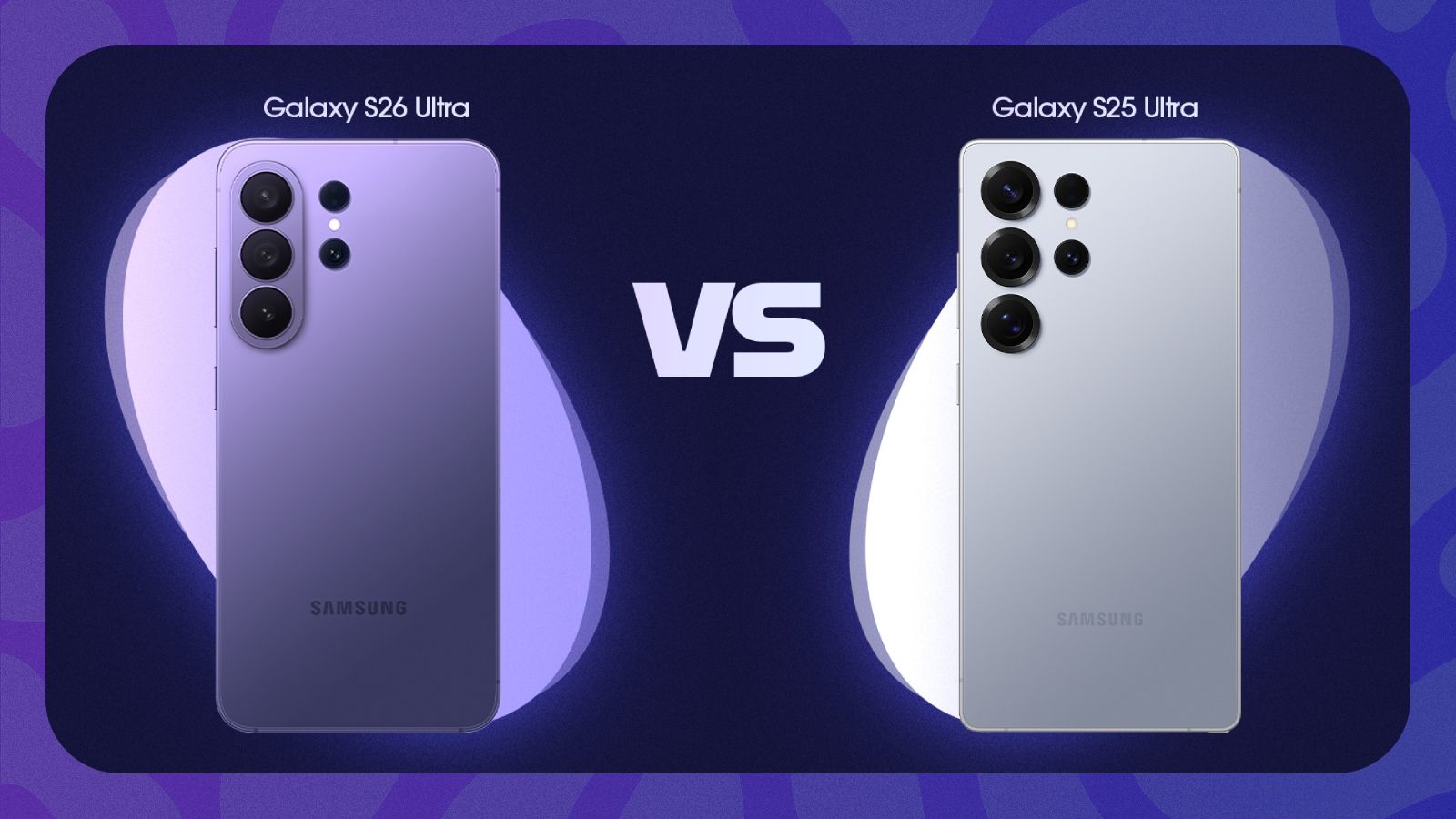
Samsung Galaxy S26 vs. Galaxy S25: Evolution or Iteration?
It’s time to upgrade your Galaxy, and the new Galaxy S26 series is officially on the radar. If the "fun-sized" S26 meets your needs, you are likely weighing it against the older Galaxy S25. While the S26 is the shiny new toy, the S25 remains a formidable, more affordable alternative that offers a nearly identical user experience.
With Samsung promising 7 years of software support, choosing last year's model doesn't carry the "obsolescence" risk it once did. Here is how these two compact flagships stack up.
Core Specifications Comparison
Feature | Samsung Galaxy S26 | Samsung Galaxy S25 |
Display | 6.3" LTPO OLED (120Hz) | 6.2" LTPO OLED (120Hz) |
Weight | 167 g | 162 g |
Chipset | Exynos 2600 (Global) / SD 8 Elite Gen 5 (US) | Snapdragon 8 Elite (Global) |
Battery | 4300 mAh | 4000 mAh |
Charging | 25W Wired / 15W Wireless | 25W Wired / 15W Wireless |
Base Storage | 256GB (most markets) | 128GB |
Design and Display
The two devices share a near-identical build: Gorilla Glass Victus 2 and an Aluminum Armor 2 frame.
Dimensions: The S26 is slightly taller to accommodate a 0.1-inch larger display.
Aesthetics: The S26 features a protruding camera island that causes some wobble on flat surfaces, whereas the S25 maintains a cleaner, more flush design.
Screen Quality: Both use the same LTPO OLED technology with ~1,400 nits peak brightness. The difference in screen size is virtually unnoticeable in daily use.
Battery and Charging
This is one of the few areas where the S26 shows clear progress.
Endurance: With a 4300 mAh cell (up from 4000 mAh), the S26 pulls ahead in web browsing and video streaming tests.
Speed: Despite both being rated at 25W, the S26 features a more aggressive charging curve. It hits 62% in 30 minutes, while the S25 reaches 56% in the same timeframe.
Performance: Exynos vs. Snapdragon
For the S26, Samsung returns to a dual-chip strategy. While the US gets the Snapdragon 8 Elite Gen 5, the global market receives the Exynos 2600.
Benchmark Comparison:
AnTuTu 10: S26 (2,441,481) vs. S25 (2,193,701)
Geekbench 6: S26 (10,824) vs. S25 (10,050)
The Exynos 2600, built on a 2nm process, offers roughly an 8–11% performance bump over the S25's Snapdragon 8 Elite. It’s an improvement, but not a life-changing one for the average user.
Camera & Video
The rear camera hardware is essentially frozen in time—both phones use the same 50MP main, 3x telephoto, and ultrawide sensors.
Daylight: The S26 tends to have a warmer color rendition, especially in greenery, with slightly finer detail structure.
Low Light: Neither phone is a "night owl" champion. The S26 relies on an auto-night mode that can be inconsistent, while the S25 remains a dependable, if slightly noisier, shooter.
Selfies: A genuine win for the S26. It features a new 23mm wide-angle lens that is sharper and more versatile than the S25's narrower 25-26mm optics.
Video: Both support 8K30. The S26 adds Horizon lock and LUT support for Log recording, which appeals to niche creators.
Final Verdict: Which should you buy?
The Galaxy S26 is a refined "refresh." It offers better battery life, superior speakers, and a much-improved selfie camera. However, the S25 provides roughly 90% of the same experience for significantly less money.
Choose the Galaxy S26 if you want:
Maximum battery endurance.
Superior selfie quality and wider front-facing shots.
Slightly faster charging and the latest 2nm processing.
Choose the Galaxy S25 if you want:
The best value for your money.
A cleaner back design without the wobbling camera island.
The proven reliability of the Snapdragon 8 Elite chipset globally.
The bottom line: Unless you are a heavy selfie-taker or desperate for that extra hour of screen-on time, the Galaxy S25 is the more sensible purchase in 2026.